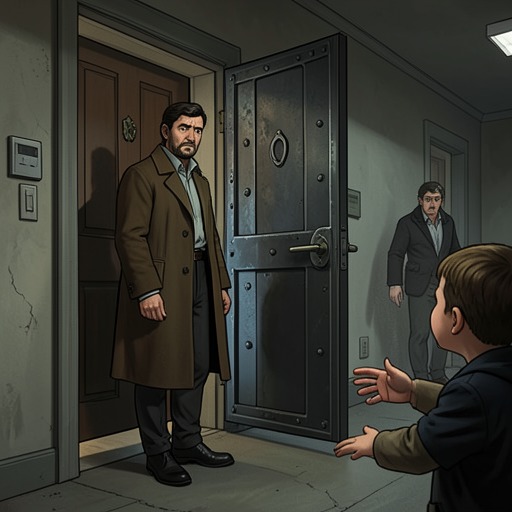
Pip reveals Estella's survival to Magwitch
Great ExpectationsPip reveals Estella’s survival to Magwitch in the condemned man’s final moments, transforming a deathbed visit into an act of belated truth and tenderness. Magwitch learns that the child he loved and lost is alive, a lady, and loved by Pip; his answer is a final gesture of affection, after which he quietly dies. The exchange joins the novel’s two central reckonings: Pip’s love for Estella and his hard-won recognition of the humanity of the convict who made his fortunes possible.
The Deathbed Disclosure
The prison governor has allowed Pip to remain beside Magwitch after the allotted time. When the governor and an officer step away, Magwitch looks at Pip with affection. Pip addresses him as “Dear Magwitch” and asks whether he understands. Magwitch answers with a gentle pressure of Pip’s hand, a small sign that he can still receive what Pip is about to say.
Pip first reminds him that he once had a child whom he loved and lost. Magwitch presses his hand more strongly. Pip then tells him that she lived, found powerful friends, and is living still: she is a lady, very beautiful, and loved by Pip. The disclosure is brief and carefully sequenced. Pip establishes the child’s survival before naming the life she has made, and ends with the personal truth that links Magwitch’s lost daughter to his own deepest attachment.
Magwitch’s Response and Death
Magwitch cannot answer in words. With a last faint effort, he raises Pip’s hand to his lips, helped by Pip’s yielding to the gesture, then lets it sink back onto his breast and lays his own hands over it. His gaze returns to the white ceiling; it passes away, and his head drops quietly onto his breast. The scene gives the revelation no spoken confirmation from Magwitch, but his touch supplies its answer: the news reaches him, and his final act is one of tenderness toward Pip.
The narrative closes the encounter not with triumph but with death. Pip thinks of the two men who went up into the Temple to pray and finds no better words beside Magwitch’s bed than a plea for mercy for a sinner. The prayer does not erase Magwitch’s past or the law’s judgment; instead, it marks a change in Pip, who can now meet him as a person deserving compassion rather than merely as the source of a frightening secret or a compromised fortune.
The Truth Behind Pip’s Love
The disclosure carries particular weight because Pip’s love for Estella has long been entangled with his expectations and mistaken hopes. He once imagined that Miss Havisham had adopted them both and intended to bring them together, casting himself as the romantic hero who would restore Satis House and marry its princess. But Pip later recognizes that Estella was never designed for him. His love persists not because he believes her perfect or destined to be his, but because he finds her irresistible, even when he knows that loving her works against reason, hope, peace, and happiness.
At Magwitch’s bedside, that love is no longer merely the private engine of Pip’s longing. By telling Magwitch that Estella is alive and that he loves her, Pip connects the convict’s lost child with the woman who has shaped his own emotional life. The information offers Magwitch a final knowledge he could not otherwise have had: the child survived and became a lady, and Pip’s attachment to her is real. The moment does not promise a union between Pip and Estella; it speaks instead to the survival of a life and of love despite loss and disappointment.
Reversal in Pip’s Moral Understanding
Earlier, the discovery that Magwitch was his benefactor had shattered the story Pip had constructed around his rise. He had expected Miss Havisham to be the source of his fortune and had imagined Estella as its intended reward. Learning the truth made those expectations collapse at once: Miss Havisham had used him as a model on which to practise emotional cruelty, Estella had not been intended for him, and the fortune came from a convict facing death. Pip’s first shock was also a recognition of what his ambitions had cost. He understood that he had deserted Joe, yet felt unable to return to Joe or Biddy because the shame of his own conduct seemed insurmountable.
The deathbed disclosure reverses that earlier estrangement from Magwitch. Pip no longer treats the convict as a disgraceful interruption of his imagined gentlemanly life. He stays with him, gives him news of the daughter Magwitch lost, and speaks compassionately at his death. The movement from fear and disillusionment toward care is not a restoration of Pip’s former expectations; it is a moral change formed through the collapse of those expectations. Magwitch’s last gesture, the pressure and kiss of Pip’s hand, seals their relationship in a form of affection that wealth and social standing could never have supplied.